

Executive Summary#
Positioning#
Late-August Re-underwriting#
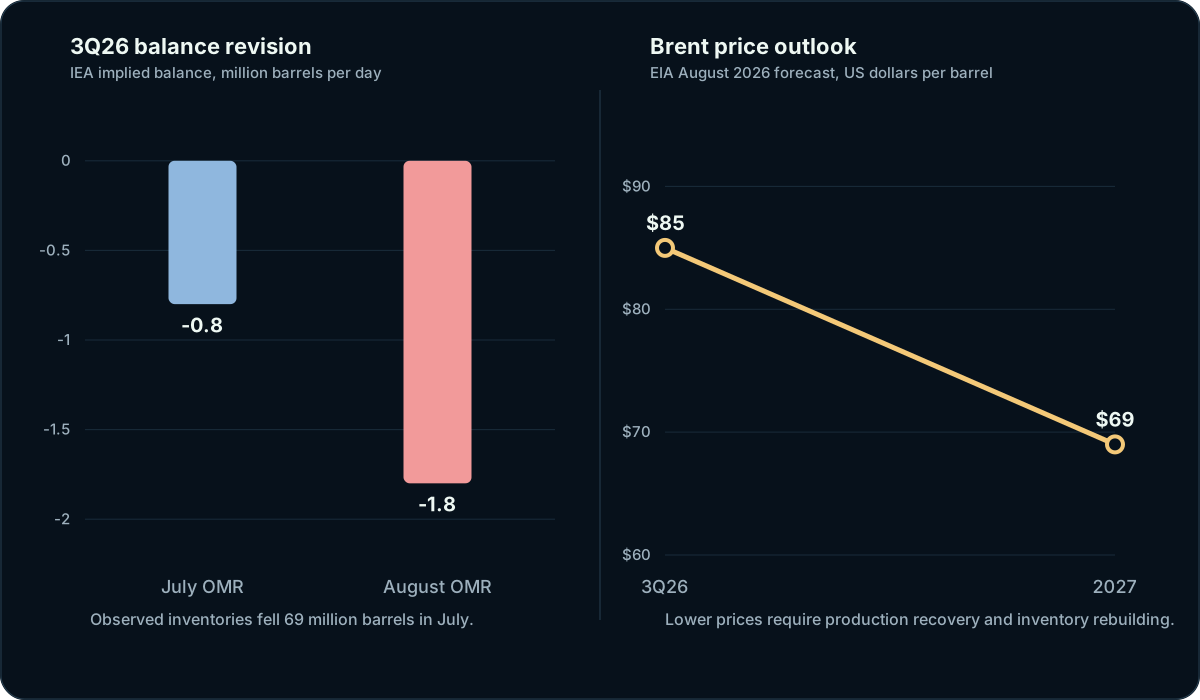
The August evidence invalidated the assumption that Gulf normalisation would continue smoothly. The IEA estimated that 8.3 mb/d of Gulf output remained shut in during July, while total Gulf exports fell to 15 mb/d after loading rates deteriorated later in the month. Its forecast 3Q deficit more than doubled from approximately 0.8 mb/d in July’s report to 1.8 mb/d in August.
Inventory confirmation also moved against the prompt short. Global observed stocks fell by 69 million barrels in July and were 410 million barrels lower than at the start of the conflict. The decline was concentrated in oil on water, but rapidly depleted buffers still increase the price sensitivity of any further disruption.
The offset is a weaker demand and longer-run price outlook. The IEA now expects global oil demand to decline by 1.6 mb/d in 2026, while projecting a return to surplus towards year-end. The EIA expects Brent to average around $85/bbl in 3Q26 before falling gradually as production and inventories recover, reaching an average of $69/bbl in 2027.
The disciplined response is to reduce conviction and extend the horizon. A bearish view should now require evidence of improving Hormuz transit, recovering Gulf production and sustained onshore inventory builds rather than relying on an agency balance forecast alone.
Investment Thesis#
1. The Market Is Pricing an Ongoing Disruption, Not a Permanent Loss of Supply#
Oil prices have repeatedly repriced the probability of renewed Gulf disruption. That risk is legitimate: the Strait of Hormuz remains the world’s most important oil transit chokepoint, and shipping, insurance and infrastructure constraints can create nonlinear upside.
However, the physical system has already shown an ability to adapt. The IEA estimated that Gulf oil exports rose by 6.5 mb/d in June to 16.1 mb/d, while global supply rebounded by 4.1 mb/d. Output remained below pre-conflict levels, but the direction of travel changed materially.
More recent shipping data reinforced both sides of the argument. Reuters reported on 19 July that exports from major Gulf producers had risen by approximately 16% from June to around 12–13 mb/d, while remaining about 32% below the pre-war February peak and slowing again as hostilities resumed.
At elevated prices, Brent therefore needs repeated evidence of lost barrels merely to hold its risk premium. A continued recovery in flows can pressure prices even without a comprehensive political settlement, but renewed transit disruption remains the central invalidation risk.
2. The Fourth-Quarter Balance Is the Core Bearish Catalyst#
The EIA expects most regional production and trade patterns to return close to pre-conflict levels by year-end. Its July outlook forecasts global inventories moving from a 2.2 mb/d draw in 3Q26 to a 2.7 mb/d build in 4Q26 as supply recovers faster than consumption.
The IEA reaches a directionally similar conclusion. Its July report states that the global balance is set to swing back towards surplus later in the year, conditional on a gradual recovery in tanker flows.
That timing matters. The bearish thesis does not require immediate oversupply in the prompt market. It requires the market to discount a looser fourth quarter before the physical builds are fully visible.
3. Full-Year Demand Is Weak Even as Consumption Recovers From the May Trough#
The IEA expects global demand to decline by 1.0 mb/d in 2026, while the EIA estimates a 1.2 mb/d decline. Both forecasts assume a recovery from the extreme disruption-driven trough, but neither implies strong full-year consumption.
This is not a conventional recessionary oil thesis. Some of the demand weakness reflects high prices, shortages and government conservation measures during the conflict. Nevertheless, it demonstrates that end users can reduce or defer consumption when the delivered cost of energy becomes sufficiently high.
Demand recovery in 4Q26 may therefore coexist with a looser balance if supply normalises faster.
4. Tight Product Markets Do Not Necessarily Mean Tight Crude#
Global refinery runs remained approximately 6 mb/d below the prior year in June, and the IEA expects runs to fall by 2.4 mb/d in 2026. Gulf export refineries had not fully restarted, Russian throughput was constrained and parts of Asia continued to operate at reduced rates.
This creates an unusual split: crude availability can improve while product markets remain tight. Strong cracks and refinery margins are therefore not sufficient evidence that Brent itself should retain the full geopolitical premium.
For the crude balance, lower refinery throughput reduces immediate feedstock demand and can accelerate inventory rebuilding once tanker flows recover.
5. Official Forecasts Provide a Useful Directional Anchor#
The EIA forecasts Brent falling from an average of $103/bbl in 2Q26 to $70/bbl in 4Q26, then averaging $65/bbl in 2027. This is not a precise target and should not be treated as one. It is a balance-based anchor showing how much downside is possible if production and trade recover broadly as expected.
My $70–80/bbl base-case range is deliberately wider and more conservative. It assumes that a residual geopolitical premium persists and that inventory rebuilding is slower or less visible than the EIA’s central case.
6. The View Is Bearish, Not Complacent#
The largest risk is discontinuous rather than incremental. A renewed closure of Hormuz, direct damage to key export terminals or coordinated production restraint could rapidly invalidate the thesis.
The correct implementation is therefore asymmetric: avoid uncapped short exposure, use defined risk and prefer rallies that improve the entry price. The thesis is about expected normalisation over months, not the absence of tail risk over days.
Original July Data Snapshot#
| Indicator | Latest cited reading | Investment relevance |
|---|---|---|
| IEA 2026 demand change | -1.0 mb/d | Weak full-year demand despite a 4Q recovery |
| IEA June supply rebound | +4.1 mb/d m/m | Evidence that Gulf flows can recover materially |
| IEA 2026 refinery-run change | -2.4 mb/d | Tight products can coexist with softer crude demand |
| EIA 4Q26 inventory balance | +2.7 mb/d build | Principal medium-term bearish catalyst |
| EIA 4Q26 Brent forecast | $70/bbl | Directional anchor for the base-case range |
Figures are source estimates rather than independently modelled forecasts.
Catalysts#
Principal Risks#
Scenario Framework#
| Scenario | Probability | 4Q26 Brent range | Key assumptions |
|---|---|---|---|
| Bear case | 25% | $60–70/bbl | Rapid flow normalisation, weak demand and visible inventory builds |
| Base case | 50% | $70–80/bbl | Gradual Gulf recovery, residual risk premium and a looser 4Q balance |
| Bull case | 25% | $95–120/bbl | Renewed export disruption or lasting damage to regional infrastructure |
The probabilities and ranges are judgemental and should be updated as physical-flow data changes.
What I Would Monitor#
- Gulf export volumes, tanker traffic and insurance premia
- Strait of Hormuz and Bab el-Mandeb transit data
- OECD and non-OECD commercial inventories
- OPEC+ production policy and compliance
- Global refinery utilisation and product cracks
- Brent time spreads and physical differentials
- Government stock releases and subsequent restocking
Conclusion#
Brent remains exposed to extreme geopolitical outcomes, but the medium-term base case is becoming less supportive. Supply has started to recover, full-year demand remains weak, refinery throughput is constrained and both the EIA and IEA expect the balance to loosen later in 2026 if Gulf flows continue to normalise.
The original July thesis identified the correct medium-term mechanism but underestimated the persistence of transit disruption and the speed at which inventory buffers could fall. A prompt bearish position is no longer justified by the balance of evidence.
The current stance is mildly bearish over six to twelve months. It depends on verified supply recovery and inventory rebuilding, not simply the passage of time. The original $70–80/bbl 4Q26 range remains part of the decision record rather than being retroactively replaced.
Research Methodology#
This note triangulates official agency balances, benchmark-price context, refinery data and physical-flow indicators. The scenario ranges are judgemental rather than outputs from a proprietary pricing model. The 27 August review preserves the original July assumptions and distinguishes subsequent evidence from information available at publication.
Original data cut-off: 19 July 2026. Re-underwriting cut-off: 27 August 2026.
Sources#
- US Energy Information Administration — Short-Term Energy Outlook, July 2026
- US Energy Information Administration — Global Oil Markets
- International Energy Agency — Oil Market Report, July 2026
- International Energy Agency — Oil Market Report, June 2026
- US Energy Information Administration — Short-Term Energy Outlook, August 2026
- International Energy Agency — Oil Market Report, August 2026
- International Energy Agency — The Middle East and Global Energy Markets
- Reuters — Oil Settles Higher on Renewed US-Iran Hostilities, 17 July 2026
- Reuters — Gulf Crude Exports Rise but Shipments Slow, 19 July 2026
The original view reflects information available through 19 July 2026 and the re-underwriting reflects evidence available through 27 August 2026. It is provided for educational and informational purposes only and does not constitute investment advice, a solicitation or a recommendation to transact in any security or commodity.