

This section presents selected empirical research, financial modelling and investment case work. The emphasis is on the analytical question, methodology, measurable output, limitations and lessons rather than on displaying a spreadsheet or codebase without context.
Empirical Research
Revised empirical study
Inflation Regimes and Commodity-Producer Equity Sensitivity
An audited Python and Excel study of whether the sensitivity of commodity-producer equity returns to underlying commodity returns changes when inflation is elevated.
- Sample
- 89 usable monthly observations
- Method
- Interaction OLS · Newey–West/HAC inference
- Tools
- Python · Excel · statsmodels
A data audit identified 14 observations created by forward-filling missing futures prices before calculating returns. The revised study excludes those artificial zero-return months, classifies the regime using the previous month's headline CPI rate and estimates full-sample interaction models with Newey–West standard errors.
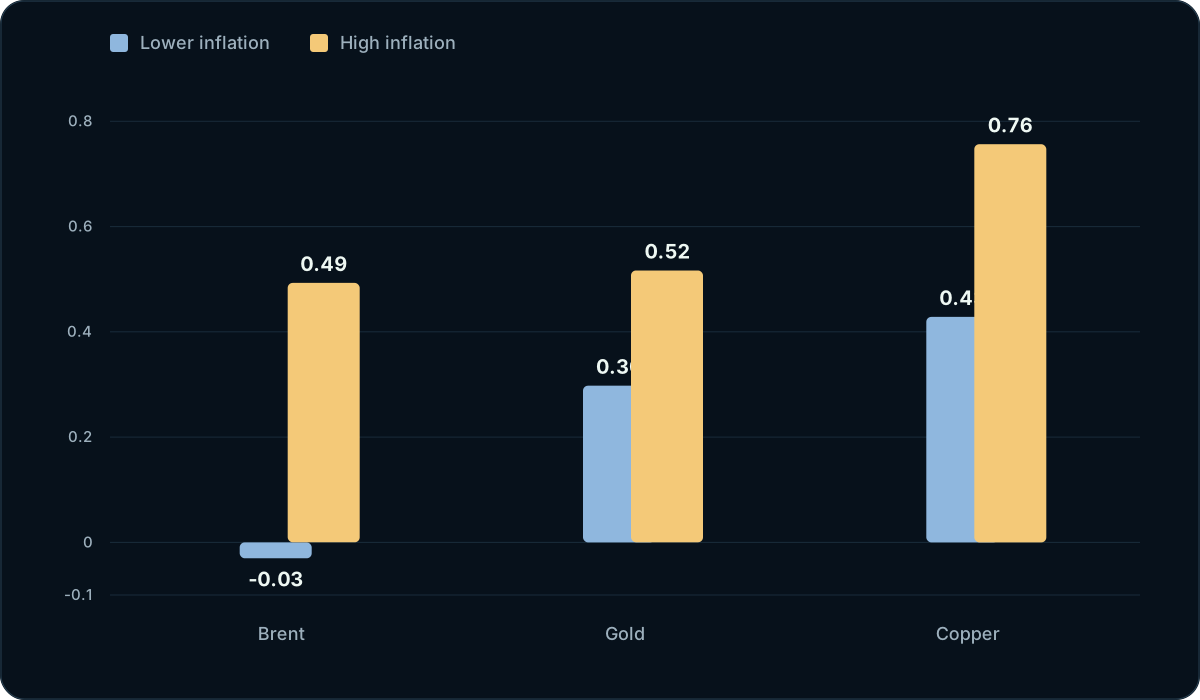
- Brent's estimated sensitivity to energy-equity returns increased from -0.030 in lower-inflation months to 0.493 in high-inflation months; the difference was statistically significant (HAC p = 0.016).
- The original claim of a reliable high-inflation increase in gold sensitivity was withdrawn after the correction (interaction p = 0.680).
- Copper remained positively associated with mining-equity returns, but the estimated regime difference was not statistically precise at the primary 3% threshold (interaction p = 0.355).
Financial Modelling
Timed valuation case
Tesla Operating Model and Valuation
An integrated Excel case covering revenue forecasting, income-statement projections, cost of capital, discounted cash flow valuation and trading comparables.
- Company
- Tesla, Inc.
- Methods
- Operating model · DCF · trading comparables
- Format
- Timed Excel assessment
- Forecast horizon
- Through 2030
The model forecast Tesla’s income statement through 2030 using alternative revenue scenarios, operating-margin assumptions and working-capital drivers. I estimated beta from daily Tesla and Nasdaq returns, calculated WACC and valued the business using a perpetuity-growth DCF.
Built revenue, cost, operating-income, EBITDA and unlevered free-cash-flow projections.
Constructed WACC from the risk-free rate, equity beta, implied equity-risk premium and after-tax cost of debt.
Compared DCF output with trading multiples and a valuation football field.
Limitations: the timed format constrained sensitivity depth, the workbook contains third-party assessment material and the valuation depends materially on long-duration margin and terminal-value assumptions. The public summary therefore describes the method without presenting the output as a live Tesla recommendation.
Selected Analytical Work
The projects below are concise records of the question and analytical process. Supporting files are published only where they can be checked independently and redistributed appropriately.
Dual-Role Global Markets Simulation
Across repeated live simulations, the strongest buy-side session produced a 93.05% score, $3.80m of portal-reported P&L and a 19.0% return, becoming the highest valid finisher after the displayed first-place entry was voided. The strongest sell-side session separately ranked 8th of 93.
Displayed 2nd/102; highest valid after void · 19.0% return · 1.20 Sharpe · 8th/93 sell sideReview simulationTrading Strategy Research and Validation
Developed and tested systematic strategies with attention to overfitting, signal robustness, execution constraints and live behaviour under changing market conditions.
Inventory-Aware Exchange Simulation
Built an automated Python trading system combining directional signals, inventory-aware market making and relative-value logic in a live exchange simulation.
Business Services Buyout Memorandum
Analysed European business-services subsectors using comparable companies, precedent transactions and DCF, focusing on the divide between AI-exposed transactional services and recurring regulatory-facing revenue.
Digital Infrastructure Acquisition Memorandum
Evaluated European data-centre platforms through power availability, grid access, utilisation, development pipelines, customer concentration and comparable transactions.
Private Equity Secondaries Memorandum
Compared LP-led portfolios and GP-led continuation vehicles through portfolio quality, vintage and concentration risk, NAV pricing, cash-flow timing and incentive alignment.
These projects are records of analytical process rather than definitive forecasts. Methodological limitations, revisions and failed assumptions remain part of the published record.