

Executive Summary#
Positioning#
Late-August Re-underwriting#
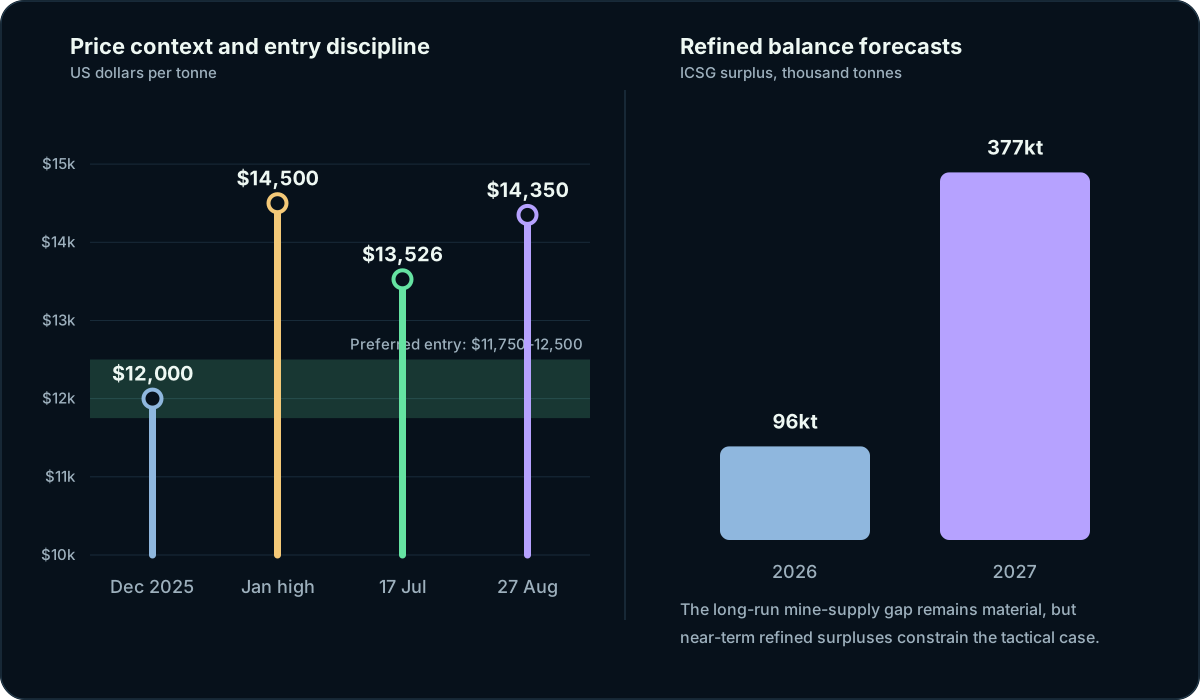
The price signal strengthened while the near-term balance evidence did not. Copper moved back towards the January high, but the latest available ICSG forecast still anticipates a 96,000-tonne refined surplus in 2026 and a larger 377,000-tonne surplus in 2027. The 2026 projection reversed the group’s earlier 150,000-tonne deficit forecast because expected usage was reduced and secondary refined supply increased.
That forecast is not definitive. ICSG explicitly notes that unreported Chinese stocks can materially change the apparent balance and that actual outcomes have diverged from prior forecasts. Concentrate scarcity also remains visible: refined-production growth is constrained even as scrap and new capacity cushion the balance.
The combination strengthens the original neutral conclusion. Higher prices reduce the margin of safety, while structural mine constraints and the location of visible metal still make an outright bearish view too simple. I would change stance only after broad inventory, spread and physical-premium evidence confirms that one side of the tension is dominating.
Investment Thesis#
1. The Structural Supply Gap Remains the Long-Term Anchor#
The IEA’s 2026 Critical Minerals Outlook still projects a copper supply gap of approximately 25% by 2035 under its base-case project pipeline. The deficit narrowed from the prior year’s estimate as projects advanced in the DRC and Zambia, but it remains unusually large for a globally traded base metal.
Copper also has a broad and difficult-to-substitute demand base. Grid reinforcement, renewable generation, electric transport, industrial electrification and data centres all require conductive metal. These uses support a higher long-run incentive price and reduce the probability of a sustained collapse in investment.
A strong secular case, however, does not make every entry price attractive.
2. Current Prices Already Capitalise Much of the Scarcity Narrative#
Copper briefly traded above $14,500/t intraday in January 2026, having first crossed $12,000/t only in December 2025. The LME three-month close on 17 July remained around $13,526/t.
At those levels, the market is not waiting for a future shortage; it is already discounting one. High prices can persist when inventories are inaccessible or mine disruptions intensify, but the valuation leaves less protection against slower demand, successful project ramp-ups or speculative liquidation.
The neutral view is therefore primarily about entry price and expected return, not disagreement with the long-term demand thesis.
3. Visible Stocks Are High, but Their Location Distorts the Signal#
Global visible copper stocks have risen materially in 2026. A large share of the increase has accumulated in the United States as tariff uncertainty pulled metal towards COMEX warehouses and changed trade incentives.
This makes the headline total difficult to interpret. Metal in a US warehouse is not automatically available to a Chinese or European consumer at the same economics, specification and timing. Conversely, the distortion can reverse: a policy change may release inventory back into the international market and remove an artificial source of tightness elsewhere.
The correct conclusion is not that inventory is irrelevant. It is that broad-based stock movements across LME, SHFE, COMEX and bonded warehouses matter more than any single headline number.
4. Concentrate Tightness Supports the Structural Case, but Smelter Stress Is Not a Simple Bullish Signal#
The IEA reports that benchmark copper treatment and refining charges were settled at $0/t in 2026, with spot charges remaining negative. This reflects tight concentrate availability and rapid smelter-capacity growth, particularly in China.
For miners, this is evidence that raw-material supply remains constrained. For the integrated copper balance, the signal is more nuanced. Smelter financial stress can curtail refined output, but high capacity and policy support can also keep plants operating despite poor standalone economics.
Treatment charges should therefore be monitored alongside refined production and physical premiums rather than used as a standalone price signal.
5. Major Producers Show Both Constraint and Adaptability#
The supply story is not uniformly bearish or bullish. BHP produced roughly 2 million tonnes of copper for a second consecutive year in FY26, supported by strong performance at Escondida. That demonstrates that operational improvement and capital investment can offset lower grades at high-quality assets.
At the same time, BHP’s March review showed lower Escondida feed grades and operational difficulties at Spence, illustrating the geological and processing challenges embedded in mature assets. The producer response is real, but it is capital-intensive, slow and uneven.
This mixed evidence supports neutrality: the market faces a long-term project challenge, but near-term supply is not collapsing across the board.
6. Near-Term Demand Has More Price Elasticity Than the Structural Narrative Suggests#
Grid and digital-infrastructure demand are durable, yet high prices can still change purchasing behaviour. Fabricators can destock, defer orders, increase scrap use or redesign products. Slower construction and manufacturing activity can also offset strength in strategic sectors over shorter periods.
The IEA’s own analysis highlights that record prices were amplified by lower interest rates, a softer dollar, investor demand for physical assets and financial speculation. Those supports can reverse more quickly than mine supply or grid demand.
A neutral position therefore preserves exposure to the structural thesis without assuming that every driver remains favourable over the next quarter or two.
Data Snapshot#
| Indicator | Latest cited reading | Investment relevance |
|---|---|---|
| LME three-month, accessed 27 Aug | $14,349.50/t | Price has returned near the 2026 high |
| LME three-month close, 17 Jul 2026 | ~$13,526/t | Valuation already embeds substantial scarcity |
| ICSG 2026 refined balance forecast | +96,000 tonnes | Modest surplus limits near-term scarcity signal |
| ICSG 2027 refined balance forecast | +377,000 tonnes | Supply response remains relevant to valuation |
| 2026 intraday high | >$14,500/t | Demonstrates the scale of the re-rating |
| IEA projected 2035 supply gap | ~25% | Supports the long-duration bull case |
| 2026 benchmark treatment charge | $0/t | Signals tight concentrate and smelter stress |
| BHP FY26 copper production | ~2 Mt | Shows supply can respond at high-quality assets |
Figures are source observations and estimates rather than independently modelled forecasts.
Catalysts#
Principal Risks#
Scenario Framework#
| Scenario | Probability | 3–6 month LME range | Key assumptions |
|---|---|---|---|
| Bear case | 25% | $10,500–11,750/t | Inventory normalises, cyclical demand weakens and speculative length exits |
| Base case | 50% | $11,750–13,750/t | Structural tightness persists, but high prices cap near-term demand |
| Bull case | 25% | $14,500–16,000/t | Major mine disruption and broad ex-US inventory draws |
The ranges are analytical scenarios, not point forecasts.
What I Would Monitor#
- LME, COMEX, SHFE and Chinese bonded inventories
- Regional cash-to-three-month spreads and physical premiums
- Chinese refined-copper imports and semis production
- Mine guidance from BHP, Codelco, Freeport-McMoRan and major African producers
- Treatment and refining charges, smelter utilisation and curtailments
- Grid, renewable and data-centre capital expenditure
- Scrap spreads, collection rates and substitution indicators
Conclusion#
Copper remains one of the strongest long-duration commodity stories, but a sound secular thesis can still be a poor short-term trade at an aggressive valuation. A day-delayed price near $14,350/t and official refined-surplus forecasts reduce the margin of safety, while concentrate tightness and a large projected 2035 supply gap prevent a clean bearish view.
The appropriate stance remains neutral: retain a constructive multi-year outlook, avoid chasing near record levels and wait for either a meaningful pullback or stronger evidence that physical availability is tightening broadly rather than merely moving between regions.
Research Methodology#
This note combines official benchmark prices, agency supply-demand analysis, producer operating disclosures and inventory-location dynamics. Scenario ranges are judgemental rather than outputs from a proprietary price model. The 27 August review preserves the original July evidence and adds only dated subsequent observations.
Original data cut-off: 19 July 2026. Re-underwriting cut-off: 27 August 2026.
Sources#
- London Metal Exchange — LME Closing Prices
- International Energy Agency — Global Critical Minerals Outlook 2026
- International Energy Agency — Copper Prices and Strategic Pressures
- International Copper Study Group — Copper Market Forecast 2026–2027
- BHP — Operational Review for the Year Ended 30 June 2026
- BHP — Operational Review for the Nine Months Ended 31 March 2026
The original view reflects information available through 19 July 2026 and the re-underwriting reflects evidence available through 27 August 2026. It is provided for educational and informational purposes only and does not constitute investment advice, a solicitation or a recommendation to transact in any security or commodity.